Enables systematic, dependency-aware scenario exploration for group sequential designs created by gsDesign. gsDesignTune is built for design space evaluation (ranking, filtering, Pareto trade-offs) rather than claiming a single “optimal design”. With a focus on user experience, correctness, and speed, it supports off-the-shelf parallel processing with progress tracking, caching, and reproducible reporting.
Installation
You can install gsDesignTune from CRAN:
install.packages("gsDesignTune")Or try the development version from GitHub:
# install.packages("pak")
pak::pak("nanxstats/gsDesignTune")
Features
- Drop-in workflow: replace
gsDesign()/gsSurv()/gsSurvCalendar()withgsDesignTune()/gsSurvTune()/gsSurvCalendarTune(), then$run(). - Dependency-aware tuning: express design parameter dependency relationships precisely, for example, spending functions and their spending parameters.
- Grid and random search over candidate sets, with vector-valued arguments treated atomically.
- Parallel evaluation via {future} / {future.apply} with progress via {progressr}. Use any {future} backend that fits your infrastructure.
- Reproducible and auditable results: per-configuration warnings/errors and reconstructable underlying call.
- Optional caching of design objects to disk and HTML reporting via {rmarkdown}.
Quick start
Evaluate time-to-event designs:
library(gsDesign)
library(gsDesignTune)
library(future)

plan(multisession, workers = 2)

job <- gsSurvTune(
  k = 3,
  test.type = 4,
  alpha = 0.025,
  beta = 0.10,
  timing = tune_values(list(c(0.33, 0.67, 1), c(0.5, 0.75, 1))),
  hr = tune_seq(0.55, 0.75, length_out = 5),
  upper = SpendingFamily$new(
    SpendingSpec$new(sfLDOF, par = tune_fixed(0)),
    SpendingSpec$new(sfHSD, par = tune_seq(-4, 4, length_out = 9))
  ),
  lower = SpendingSpec$new(sfLDOF, par = tune_fixed(0)),
  lambdaC = log(2) / 6,
  eta = 0.01,
  gamma = c(2.5, 5, 7.5, 10),
  R = c(2, 2, 2, 6),
  T = 18,
  minfup = 6,
  ratio = 1
)

job$run(strategy = "grid", parallel = TRUE, seed = 1, cache_dir = "gstune_cache")

res <- job$results()

job$table(n = 10)| Config ID | Upper bound | Upper parameter | Timing | HR | Final events | Final total N | Power | Upper Z (IA1) | Lower Z (IA1) |
|---|---|---|---|---|---|---|---|---|---|
| 1 | sfLDOF | 0 | 0.33, 0.67, 1 | 0.55 | 124 | 222 | 0.9 | 3.73 | -0.719 |
| 2 | sfLDOF | 0 | 0.33, 0.67, 1 | 0.6 | 170 | 296 | 0.9 | 3.73 | -0.719 |
| 3 | sfLDOF | 0 | 0.33, 0.67, 1 | 0.65 | 240 | 406 | 0.9 | 3.73 | -0.719 |
| 4 | sfLDOF | 0 | 0.33, 0.67, 1 | 0.7 | 350 | 580 | 0.9 | 3.73 | -0.719 |
| 5 | sfLDOF | 0 | 0.33, 0.67, 1 | 0.75 | 538 | 874 | 0.9 | 3.73 | -0.719 |
| 6 | sfLDOF | 0 | 0.5, 0.75, 1 | 0.55 | 127 | 226 | 0.9 | 2.96 | 0.332 |
| 7 | sfLDOF | 0 | 0.5, 0.75, 1 | 0.6 | 174 | 302 | 0.9 | 2.96 | 0.332 |
| 8 | sfLDOF | 0 | 0.5, 0.75, 1 | 0.65 | 245 | 414 | 0.9 | 2.96 | 0.332 |
| 9 | sfLDOF | 0 | 0.5, 0.75, 1 | 0.7 | 357 | 592 | 0.9 | 2.96 | 0.332 |
| 10 | sfLDOF | 0 | 0.5, 0.75, 1 | 0.75 | 549 | 892 | 0.9 | 2.96 | 0.332 |
job$best("final_events", direction = "min") |>
job$table(n = 10)| Config ID | Upper bound | Upper parameter | Timing | HR | Final events | Final total N | Power | Upper Z (IA1) | Lower Z (IA1) |
|---|---|---|---|---|---|---|---|---|---|
| 1 | sfLDOF | 0 | 0.33, 0.67, 1 | 0.55 | 124 | 222 | 0.9 | 3.73 | -0.719 |
| 11 | sfHSD | -4 | 0.33, 0.67, 1 | 0.55 | 125 | 222 | 0.9 | 3.02 | -0.716 |
| 21 | sfHSD | -3 | 0.33, 0.67, 1 | 0.55 | 126 | 224 | 0.9 | 2.85 | -0.707 |
| 6 | sfLDOF | 0 | 0.5, 0.75, 1 | 0.55 | 127 | 226 | 0.9 | 2.96 | 0.332 |
| 16 | sfHSD | -4 | 0.5, 0.75, 1 | 0.55 | 127 | 226 | 0.9 | 2.75 | 0.332 |
| 31 | sfHSD | -2 | 0.33, 0.67, 1 | 0.55 | 128 | 228 | 0.9 | 2.68 | -0.692 |
| 26 | sfHSD | -3 | 0.5, 0.75, 1 | 0.55 | 128 | 228 | 0.9 | 2.61 | 0.344 |
| 36 | sfHSD | -2 | 0.5, 0.75, 1 | 0.55 | 130 | 232 | 0.9 | 2.47 | 0.361 |
| 41 | sfHSD | -1 | 0.33, 0.67, 1 | 0.55 | 131 | 232 | 0.9 | 2.53 | -0.67 |
| 46 | sfHSD | -1 | 0.5, 0.75, 1 | 0.55 | 133 | 236 | 0.9 | 2.35 | 0.387 |
job$pareto(
  metrics = c("final_events", "upper_z1"),
  directions = c("min", "min")
) |> job$table(n = 10)| Config ID | Upper bound | Upper parameter | Timing | Final events | Final total N | Power | Upper Z (IA1) | Lower Z (IA1) |
|---|---|---|---|---|---|---|---|---|
| 1 | sfLDOF | 0 | 0.33, 0.67, 1 | 124 | 222 | 0.9 | 3.73 | -0.719 |
| 11 | sfHSD | -4 | 0.33, 0.67, 1 | 125 | 222 | 0.9 | 3.02 | -0.716 |
| 16 | sfHSD | -4 | 0.5, 0.75, 1 | 127 | 226 | 0.9 | 2.75 | 0.332 |
| 21 | sfHSD | -3 | 0.33, 0.67, 1 | 126 | 224 | 0.9 | 2.85 | -0.707 |
| 26 | sfHSD | -3 | 0.5, 0.75, 1 | 128 | 228 | 0.9 | 2.61 | 0.344 |
| 31 | sfHSD | -2 | 0.33, 0.67, 1 | 128 | 228 | 0.9 | 2.68 | -0.692 |
| 36 | sfHSD | -2 | 0.5, 0.75, 1 | 130 | 232 | 0.9 | 2.47 | 0.361 |
| 46 | sfHSD | -1 | 0.5, 0.75, 1 | 133 | 236 | 0.9 | 2.35 | 0.387 |
| 56 | sfHSD | 0 | 0.5, 0.75, 1 | 137 | 244 | 0.9 | 2.24 | 0.423 |
| 66 | sfHSD | 1 | 0.5, 0.75, 1 | 142 | 254 | 0.9 | 2.16 | 0.47 |
job$plot(metric = "final_events", x = "hr", color = "upper_fun")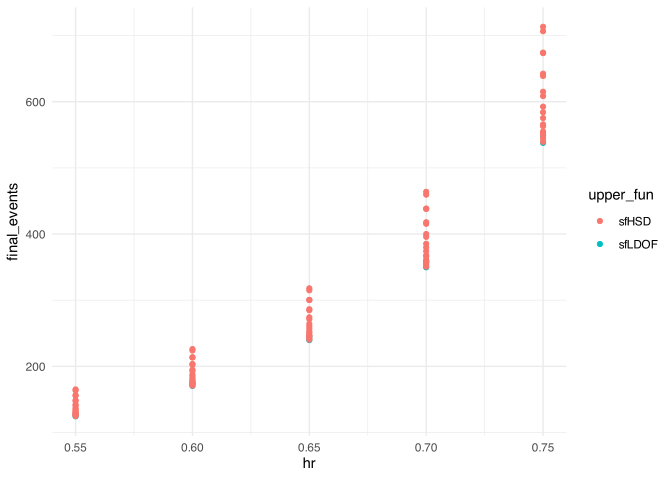
job$report("gstune_report.html")Tune specifications
-
tune_fixed(x): explicit fixed value (useful inside dependencies) -
tune_values(list(...)): explicit candidates (supports vector-valued candidates) -
tune_seq(from, to, length_out),tune_int(from, to, by) -
tune_choice(...): categorical choices -
tune_dep(depends_on, map): dependent mapping for any argument
See vignettes for end-to-end examples, spending function tuning, and parallel + reproducible reporting.