This vignette demonstrates dependency-aware grid search over group sequential designs using gsDesignTune.
Basic designs with gsDesignTune()
gsDesignTune() wraps gsDesign::gsDesign()
for tuning basic group sequential designs.
job <- gsDesignTune(
  k = 3,
  test.type = 2,
  alpha = 0.025,
  beta = 0.10,
  timing = tune_values(list(c(0.33, 0.67, 1), c(0.5, 0.75, 1))),
  upper = SpendingFamily$new(
    SpendingSpec$new(sfLDOF, par = tune_fixed(0)),
    SpendingSpec$new(sfHSD, par = tune_seq(-4, 4, length_out = 3))
  )
)

job$run(strategy = "grid", parallel = FALSE)
res <- job$results()
job$table(n = 6)| Config ID | Upper bound | Upper parameter | Timing | Final N | Power | Upper Z (IA1) | Lower Z (IA1) |
|---|---|---|---|---|---|---|---|
| 1 | sfLDOF | 0 | 0.33, 0.67, 1 | 1.01 | 0.9 | 3.73 | -3.73 |
| 2 | sfLDOF | 0 | 0.5, 0.75, 1 | 1.02 | 0.9 | 2.96 | -2.96 |
| 3 | sfHSD | -4 | 0.33, 0.67, 1 | 1.02 | 0.9 | 3.02 | -3.02 |
| 4 | sfHSD | -4 | 0.5, 0.75, 1 | 1.02 | 0.9 | 2.75 | -2.75 |
| 5 | sfHSD | 0 | 0.33, 0.67, 1 | 1.11 | 0.9 | 2.4 | -2.4 |
| 6 | sfHSD | 0 | 0.5, 0.75, 1 | 1.11 | 0.9 | 2.24 | -2.24 |
Ranking and filtering
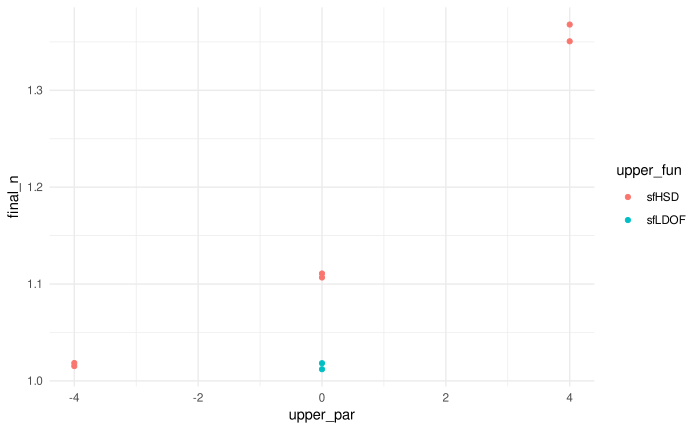
best <- job$best("final_n", direction = "min")
job$table(best, n = 10)| Config ID | Upper bound | Upper parameter | Timing | Final N | Power | Upper Z (IA1) | Lower Z (IA1) |
|---|---|---|---|---|---|---|---|
| 1 | sfLDOF | 0 | 0.33, 0.67, 1 | 1.01 | 0.9 | 3.73 | -3.73 |
| 3 | sfHSD | -4 | 0.33, 0.67, 1 | 1.02 | 0.9 | 3.02 | -3.02 |
| 2 | sfLDOF | 0 | 0.5, 0.75, 1 | 1.02 | 0.9 | 2.96 | -2.96 |
| 4 | sfHSD | -4 | 0.5, 0.75, 1 | 1.02 | 0.9 | 2.75 | -2.75 |
| 5 | sfHSD | 0 | 0.33, 0.67, 1 | 1.11 | 0.9 | 2.4 | -2.4 |
| 6 | sfHSD | 0 | 0.5, 0.75, 1 | 1.11 | 0.9 | 2.24 | -2.24 |
| 8 | sfHSD | 4 | 0.5, 0.75, 1 | 1.35 | 0.9 | 2.01 | -2.01 |
| 7 | sfHSD | 4 | 0.33, 0.67, 1 | 1.37 | 0.9 | 2.08 | -2.08 |
Survival designs with gsSurvTune()
gsSurvTune() wraps gsDesign::gsSurv() for
tuning time-to-event designs.
job_surv <- gsSurvTune(
  k = 3,
  test.type = 4,
  alpha = 0.025,
  beta = 0.10,
  timing = tune_values(list(c(0.33, 0.67, 1), c(0.5, 0.75, 1))),
  hr = tune_seq(0.60, 0.75, length_out = 3),
  upper = SpendingFamily$new(
    SpendingSpec$new(sfLDOF, par = tune_fixed(0)),
    SpendingSpec$new(sfHSD, par = tune_seq(-4, 4, length_out = 3))
  ),
  lower = SpendingSpec$new(sfLDOF, par = tune_fixed(0)),
  lambdaC = log(2) / 6,
  eta = 0.01,
  gamma = c(2.5, 5, 7.5, 10),
  R = c(2, 2, 2, 6),
  T = 18,
  minfup = 6,
  ratio = 1
)

job_surv$run(strategy = "grid", parallel = FALSE)
res_surv <- job_surv$results()
job_surv$table(n = 6)| Config ID | Upper bound | Upper parameter | Timing | HR | Final events | Final total N | Power | Upper Z (IA1) | Lower Z (IA1) |
|---|---|---|---|---|---|---|---|---|---|
| 1 | sfLDOF | 0 | 0.33, 0.67, 1 | 0.6 | 170 | 296 | 0.9 | 3.73 | -0.719 |
| 2 | sfLDOF | 0 | 0.33, 0.67, 1 | 0.675 | 288 | 482 | 0.9 | 3.73 | -0.719 |
| 3 | sfLDOF | 0 | 0.33, 0.67, 1 | 0.75 | 538 | 874 | 0.9 | 3.73 | -0.719 |
| 4 | sfLDOF | 0 | 0.5, 0.75, 1 | 0.6 | 174 | 302 | 0.9 | 2.96 | 0.332 |
| 5 | sfLDOF | 0 | 0.5, 0.75, 1 | 0.675 | 294 | 492 | 0.9 | 2.96 | 0.332 |
| 6 | sfLDOF | 0 | 0.5, 0.75, 1 | 0.75 | 549 | 892 | 0.9 | 2.96 | 0.332 |
Calendar-timed analyses with gsSurvCalendarTune()
gsSurvCalendarTune() is similar to
gsSurvTune(), but you specify planned calendar times of
analyses via calendarTime instead of information
timing.
job_cal <- gsSurvCalendarTune(
  test.type = 4,
  alpha = 0.025,
  beta = 0.10,
  calendarTime = tune_values(list(c(12, 24, 36), c(9, 18, 27))),
  spending = tune_choice("information", "calendar"),
  hr = tune_seq(0.60, 0.75, length_out = 3),
  upper = SpendingFamily$new(
    SpendingSpec$new(sfLDOF, par = tune_fixed(0)),
    SpendingSpec$new(sfHSD, par = tune_seq(-4, 4, length_out = 3))
  ),
  lower = SpendingSpec$new(sfLDOF, par = tune_fixed(0)),
  lambdaC = log(2) / 6,
  eta = 0.01,
  gamma = c(2.5, 5, 7.5, 10),
  R = c(2, 2, 2, 6),
  minfup = 18,
  ratio = 1
)

job_cal$run(strategy = "grid", parallel = FALSE)
res_cal <- job_cal$results()
job_cal$table(n = 6)| Config ID | Upper bound | Upper parameter | Calendar time | Spending | HR | Final events | Final total N | Power | Upper Z (IA1) | Lower Z (IA1) |
|---|---|---|---|---|---|---|---|---|---|---|
| 1 | sfLDOF | 0 | 12, 24, 36 | information | 0.6 | 173 | 212 | 0.9 | 4.48 | -1.565 |
| 2 | sfLDOF | 0 | 12, 24, 36 | information | 0.675 | 293 | 354 | 0.9 | 4.44 | -1.516 |
| 3 | sfLDOF | 0 | 12, 24, 36 | information | 0.75 | 549 | 650 | 0.9 | 4.39 | -1.467 |
| 4 | sfLDOF | 0 | 12, 24, 36 | calendar | 0.6 | 165 | 204 | 0.9 | 3.71 | -1.023 |
| 5 | sfLDOF | 0 | 12, 24, 36 | calendar | 0.675 | 279 | 336 | 0.9 | 3.71 | -1.01 |
| 6 | sfLDOF | 0 | 12, 24, 36 | calendar | 0.75 | 522 | 618 | 0.9 | 3.71 | -0.996 |
Multi-scenario exploration
best_surv <- job_surv$best("final_events", direction = "min")
job_surv$table(best_surv, n = 10)| Config ID | Upper bound | Upper parameter | Timing | HR | Final events | Final total N | Power | Upper Z (IA1) | Lower Z (IA1) |
|---|---|---|---|---|---|---|---|---|---|
| 1 | sfLDOF | 0 | 0.33, 0.67, 1 | 0.6 | 170 | 296 | 0.9 | 3.73 | -0.719 |
| 7 | sfHSD | -4 | 0.33, 0.67, 1 | 0.6 | 171 | 296 | 0.9 | 3.02 | -0.716 |
| 4 | sfLDOF | 0 | 0.5, 0.75, 1 | 0.6 | 174 | 302 | 0.9 | 2.96 | 0.332 |
| 10 | sfHSD | -4 | 0.5, 0.75, 1 | 0.6 | 174 | 302 | 0.9 | 2.75 | 0.332 |
| 13 | sfHSD | 0 | 0.33, 0.67, 1 | 0.6 | 185 | 320 | 0.9 | 2.4 | -0.638 |
| 16 | sfHSD | 0 | 0.5, 0.75, 1 | 0.6 | 188 | 326 | 0.9 | 2.24 | 0.423 |
| 22 | sfHSD | 4 | 0.5, 0.75, 1 | 0.6 | 224 | 388 | 0.9 | 2.01 | 0.651 |
| 19 | sfHSD | 4 | 0.33, 0.67, 1 | 0.6 | 226 | 392 | 0.9 | 2.08 | -0.428 |
| 2 | sfLDOF | 0 | 0.33, 0.67, 1 | 0.675 | 288 | 482 | 0.9 | 3.73 | -0.719 |
| 8 | sfHSD | -4 | 0.33, 0.67, 1 | 0.675 | 289 | 484 | 0.9 | 3.02 | -0.716 |
job_surv$plot(metric = "final_events", x = "hr", color = "upper_fun")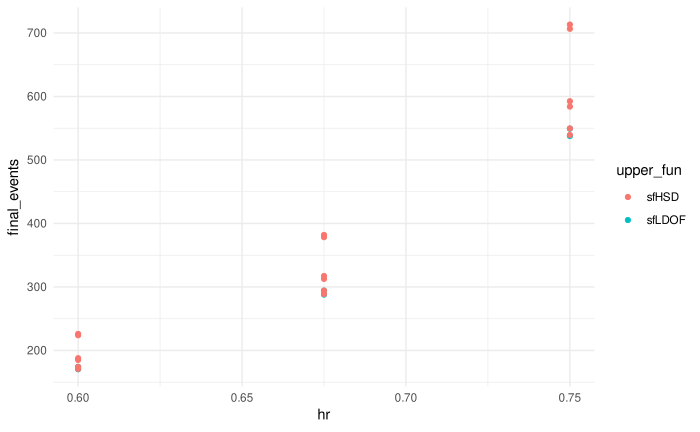
Export a report
report_path <- tempfile(fileext = ".html")
job_surv$report(report_path)
report_path
#> [1] "/tmp/RtmpSDoSXC/file1c1a78427626.html"