Introducing bisectrunk: Parallel Git bisection for real-world regressions

I’m delighted to announce the first public release of bisectrunk, a Rust CLI for parallel Git bisection of real-world software regressions.
You give it a known-good revision, a known-bad revision, and a few shell hooks that describe how your ecosystem installs and tests a commit. It then finds the commit that changed the result by evaluating several candidates at once, each in its own isolated environment. Because the hooks speak plain shell, bisectrunk adapts to whatever toolchain you use, and it works equally well when the one driving it happens to be an AI agent.
You can install it with:
cargo install bisectrunkbisectrunk is also my first experiment with pairing Claude Fable 5 (extra) as the architect and GPT-5.6 Sol (xhigh) as the builder. I gave the architect context, goals, and constraints to produce a spec and a prompt, then handed both to the builder to implement. Each step was a single conversation with quality output, although I spent hours iterating on the spec, simplifying the prompt, and laying out the project skeleton to reduce guesswork. I was proudly the bottleneck of the entire process.
Case study: tracing a visual regression through rlang
A tool in the git bisect run family is much easier to appreciate with a
genuinely messy example, so instead of a toy example, let me walk through a
software regression with real-world complexity. Everything you need to
reproduce it lives in
nanxstats/bisectrunk-rlang,
and you are welcome to run it yourself.
The regression
Shortly after rlang 1.3.0 was released, the gsDesign package started failing two vdiffr snapshot tests. The plots still looked identical, but two legends had swapped stacking order in the SVG output, and that was enough to break the snapshots.
This is a fun bisection problem because the failure surfaced two dependencies away from its true cause. gsDesign supplied the tests and the expected output, ggplot2 rendered the plots, and rlang has the commit we were looking for. So every evaluation had to keep the gsDesign and ggplot2 versions fixed while swapping in an rlang built from a different candidate commit.
The search covered rlang from v1.1.7 (7a519a2) to the then-current HEAD
b7b9861. That is 189 candidate commits, including the bad endpoint.
gsDesign was pinned at 67a3a74, the commit just before the snapshots were
regenerated and the issue resolved in
PR #283.
Designing the experiment
Each evaluation constructed the following environment:
| Component | Treatment |
|---|---|
| rlang | Checked out at the candidate commit and installed into a private library |
| ggplot2 4.0.3 | Reinstalled alongside that candidate rlang |
| gsDesign | Pinned at the pre-fix commit and installed once into a separate library |
| Test workload | Only the two affected test_that() blocks |
| Snapshot output | Written below the worker’s private BISECTRUNK_OUT directory |
Reinstalling the exact ggplot2 version for every candidate also matters:
a ggplot2 built under one rlang and reused with another might tie the result
to the state of the host library rather than to the candidate commit.
The test wrapper also prepends the controlled libraries to .libPaths(),
so a stray .Renviron setup can’t quietly swap in a different rlang
behind your back.
Rather than running the two complete test files, testthat::test_file() can
select just the two affected tests by their exact descriptions:
plot.gsDesign: ... plottype = power and base set to FALSEplot.gsProbability: ... plottype power and base set to FALSE
The wrapper first copies those files and their two baseline SVGs into each
worker’s private artifact directory. This detail earns its keep once things
run in parallel: vdiffr writes a .new.svg whenever a snapshot differs, so
workers sharing the original test directory would race over the same
output files.
One last wrinkle: older rlang commits use C declarations that R 4.6 no longer exposes by default. A small compatibility header was created to make those declarations visible during compilation, which is just enough of a shim to let every commit in the range build under the same R installation.
Running the search
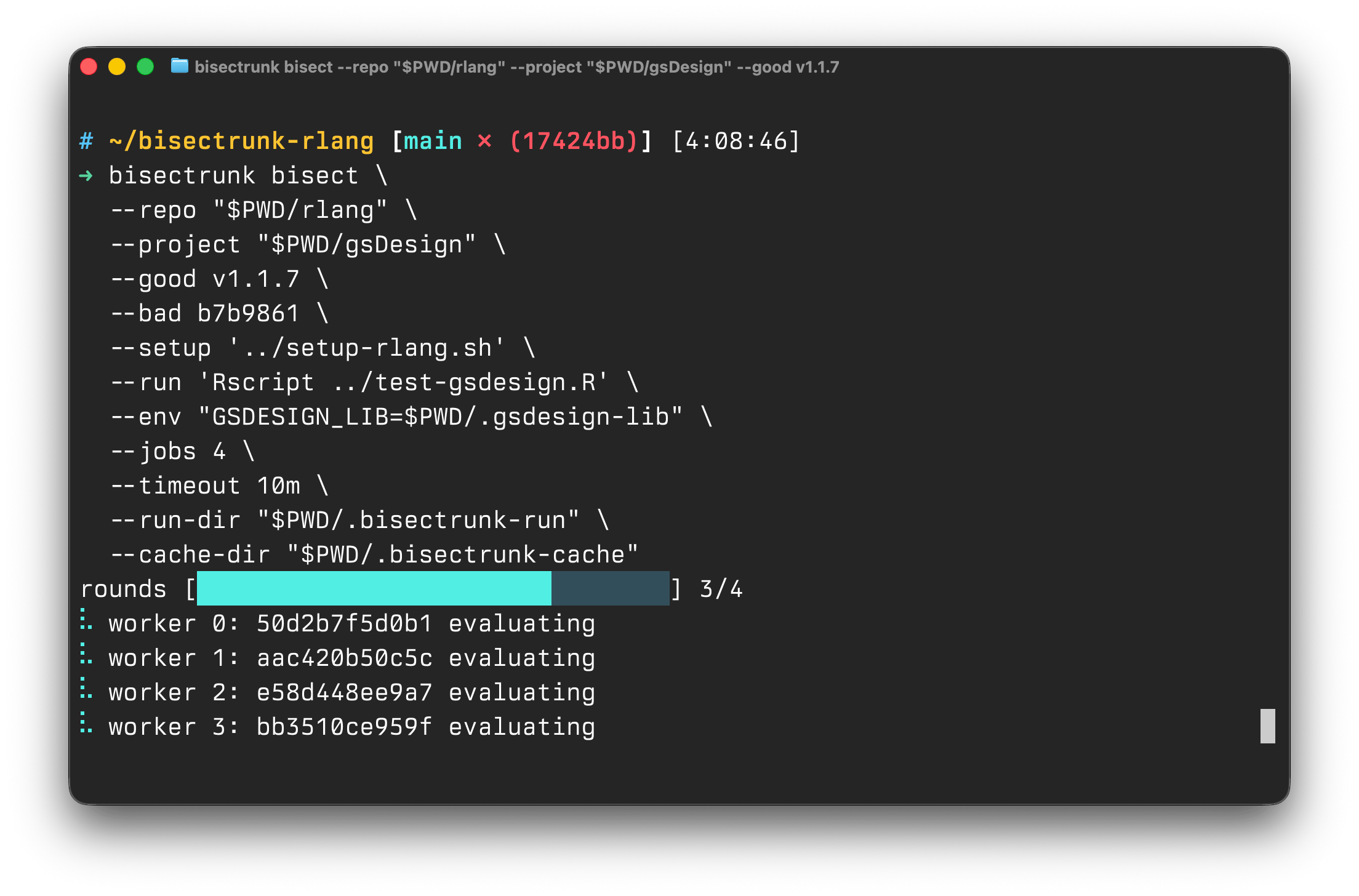
With all the inputs prepared, the complete command is refreshingly boring:
bisectrunk bisect \
  --repo "$PWD/rlang" \
  --project "$PWD/gsDesign" \
  --good v1.1.7 \
  --bad b7b9861 \
  --setup '../setup-rlang.sh' \
  --run 'Rscript ../test-gsdesign.R' \
  --env "GSDESIGN_LIB=$PWD/.gsdesign-lib" \
  --jobs 4 \
  --timeout 10m \
  --run-dir "$PWD/.bisectrunk-run" \
  --cache-dir "$PWD/.bisectrunk-cache"
The setup hook installs the candidate rlang and the pinned ggplot2 source
into BISECTRUNK_ENV. The run hook executes the focused testthat workload.
A clean snapshot comparison exits 0 and means “good”, while a changed snapshot
exits 1 and means “bad”. NOT_CRAN=true is set explicitly because vdiffr
intentionally skips these comparisons in CRAN mode.
The answer
With four workers, bisectrunk evaluated 15 of the 189 commits and reported:
first bad commit: 9899406c1a14252278303ba36b48ee3101d4eb83
last good commit: e58d448ee9a7cf2b1fa8d50e2d93424bbce636d0
The first bad commit was titled “Implement hash() with our own walker”. Its new hashing implementation changed an ordering that ggplot2’s guide collection happened to observe, which propagated all the way to two SVG snapshots in a downstream package.
The 15 evaluations might sound like more work than a sequential binary search over 189 commits would need (about 8). And as Claude says, you’re right to push back… and that’s not nothing: parallel k-section deliberately speculates and evaluates several candidates in each round so that the expensive installations overlap. It spends extra CPU to save wall time. This is a good trade when a single evaluation involves compiling rlang and reinstalling ggplot2, and 4 of them can progress at once.
Why not just use git bisect run?
In popular AI terms, it’s all about the harness.
For a fast, deterministic test contained in one repository, git bisect run remains the right tool (for real, everyone should learn it).
It has the right classification protocol, including exit code 125 for an
untestable commit, and it performs an efficient sequential search.
The example above crosses the lines where “run this command after each checkout” stops describing the problem. A correct evaluation now needs a detached checkout, a candidate-specific installation, a pinned downstream project, isolated artifacts, captured logs, and a durable classification. Running several such evaluations concurrently adds multiple worktrees and a scheduler that can narrow the range from results arriving out of order.
You could certainly build all of that around git bisect run, but you
would be writing the missing executor yourself:
- Create and clean multiple worktrees without corrupting Git’s registration.
- Assign commits to workers and reconcile out-of-order results.
- Key installation caches by repository, commit, and setup hook.
- Distinguish an unbuildable candidate from a genuine behavioral failure.
- Prevent workers from sharing mutable output paths.
- Retain per-commit setup and test logs.
- Persist enough state to resume after interruption without repeating finished installations.
At that point, choosing the midpoint has become the easy part. The real work is making every classification reproducible while many of them run at once.
So bisectrunk reinvents the execution layer of git bisect run, and
only that. The Git commit graph and the familiar good/bad/skip model stay
exactly as they are; what changes is the unit of work, from “one command in
one mutable checkout” to “one isolated, cached, inspectable experiment for
one commit”. For dependency regressions like this one, the isolation makes
the answer trustworthy, while parallel execution and resumability make the
experiment practical.
Built for humans and AI
There was one more reason to build this as a CLI: bisectrunk is a tool that AI coding agents can learn and use quickly. The inputs are explicit, the hook protocol is small, the state is durable, and the reports and per-commit logs give an agent concrete evidence for its next decision. The case study above was built entirely by an AI agent.
In a “loop engineering” workflow, an agent turns a clear goal and enough repository context into a focused test, runs the search, inspects skipped or failed commits, refines the harness, and resumes without discarding completed work. The human still decides which outcome matters and which constraints stay fixed, while the agent takes care of the repetitive experimental loop.
I have come to believe that tools designed around composable commands and inspectable state do more than automate today’s debugging: they become reliable building blocks for AI-assisted development automation.
Acknowledgements
I’m grateful for crossbeam-channel and the entire tree of Rust crates
underneath bisectrunk, which made the concurrent parts of this project a
genuine pleasure to build. And to whoever maintains the bottleneck: keep up
the good work.