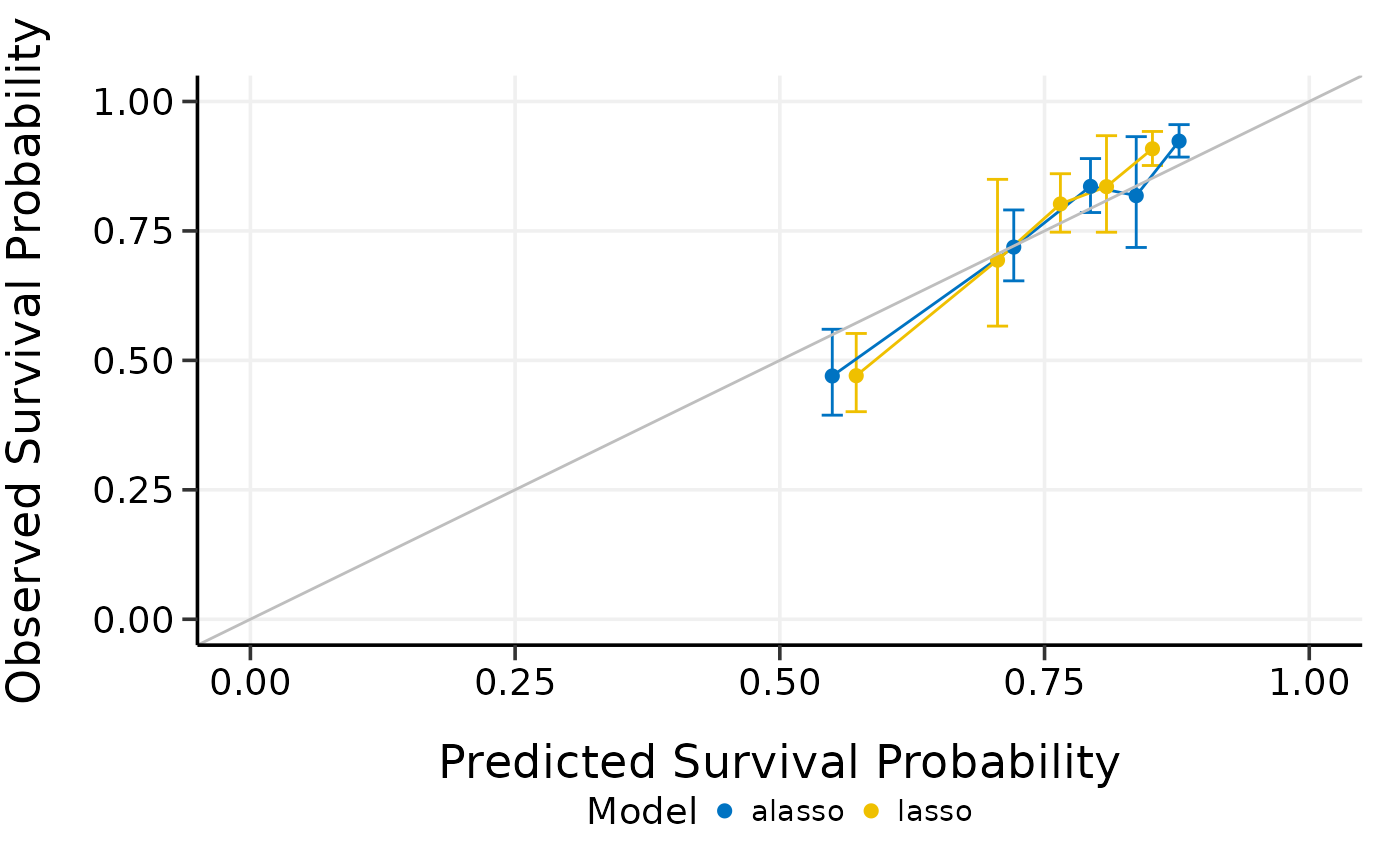
Compare high-dimensional Cox models by model calibration
Source:R/5_3_compare_by_calibrate.R
compare_by_calibrate.RdCompare high-dimensional Cox models by model calibration
Usage
compare_by_calibrate(
  x,
  time,
  event,
  model.type = c("lasso", "alasso", "flasso", "enet", "aenet", "mcp", "mnet", "scad",
    "snet"),
  method = c("fitting", "bootstrap", "cv", "repeated.cv"),
  boot.times = NULL,
  nfolds = NULL,
  rep.times = NULL,
  pred.at,
  ngroup = 5,
  rule = c("lambda.min", "lambda.1se"),
  cox.ties = c("breslow", "efron"),
  seed = 1001,
  trace = TRUE
)
Arguments
- x
Matrix of training data used for fitting the model; on which to run the calibration.
- time
Survival time. Must be of the same length with the number of rows as
x.- event
Status indicator, normally 0 = alive, 1 = dead. Must be of the same length with the number of rows as
x.- model.type
Model types to compare. Could be at least two of
"lasso","alasso","flasso","enet","aenet","mcp","mnet","scad", or"snet".- method
Calibration method. Could be
"bootstrap","cv", or"repeated.cv".- boot.times
Number of repetitions for bootstrap.
- nfolds
Number of folds for cross-validation and repeated cross-validation.
- rep.times
Number of repeated times for repeated cross-validation.
- pred.at
Time point at which calibration should take place.
- ngroup
Number of groups to be formed for calibration.
- rule
Model selection criterion for glmnet models, `"lambda.min"` or `"lambda.1se"`. Defaults to `"lambda.min"`.
- cox.ties
Cox tie-handling method for glmnet model fits and refits.
- seed
A random seed for cross-validation fold division.
- trace
Logical. Output the calibration progress or not. Default is
TRUE.
Examples
data(smart)
x <- as.matrix(smart[, -c(1, 2)])
time <- smart$TEVENT
event <- smart$EVENT

# Compare lasso and adaptive lasso by 5-fold cross-validation
cmp.cal.cv <- compare_by_calibrate(
  x, time, event,
  model.type = c("lasso", "alasso"),
  method = "fitting",
  pred.at = 365 * 9, ngroup = 5, seed = 1001
)
#> Starting model 1 : lasso
#> Start fitting ...
#> Starting model 2 : alasso
#> Start fitting ...

print(cmp.cal.cv)
#> High-Dimensional Cox Model Calibration Object
#> Random seed: 1001
#> Calibration method: fitting
#> Model type: lasso
#> glmnet model alpha: 1
#> glmnet model lambda: 0.002521583
#> glmnet model penalty factor: not specified
#> Calibration time point: 3285
#> Number of groups formed for calibration: 5
#>
#> High-Dimensional Cox Model Calibration Object
#> Random seed: 1001
#> Calibration method: fitting
#> Model type: alasso
#> glmnet model alpha: 1
#> glmnet model lambda: 0.001912884
#> glmnet model penalty factor: specified
#> Calibration time point: 3285
#> Number of groups formed for calibration: 5
#>
summary(cmp.cal.cv)
#>   Model type: lasso
#>   Calibration Summary Table
#>   Predicted  Observed Lower 95% Upper 95%
#> 1 0.5466818 0.4637830 0.3857102 0.5576587
#> 2 0.7196071 0.7316329 0.6710281 0.7977112
#> 3 0.7914195 0.8199814 0.7511298 0.8951443
#> 4 0.8386738 0.8604124 0.7892224 0.9380240
#> 5 0.8858013 0.9279530 0.8968975 0.9600839
#> attr(,"cox.ties")
#> [1] "breslow"
#>
#>   Model type: alasso
#>   Calibration Summary Table
#>   Predicted  Observed Lower 95% Upper 95%
#> 1 0.5341084 0.4535579 0.3724883 0.5522718
#> 2 0.7251070 0.7419299 0.6812376 0.8080294
#> 3 0.8014661 0.8077740 0.7324507 0.8908434
#> 4 0.8520771 0.8829392 0.8388129 0.9293868
#> 5 0.8996329 0.9265275 0.8950859 0.9590736
#> attr(,"cox.ties")
#> [1] "breslow"
#>
plot(cmp.cal.cv)